A real product tour
See relationship-aware scheduling in action.
Follow the experience on both sides of a MyCal link—from secure visitor sign-in and the right meeting choices to the host’s scheduling workspace.
For the person booking
From private sign-in to a confirmed meeting.
The visitor sees a focused, responsive path. MyCal verifies identity before revealing eligible meeting types, dates, or times.
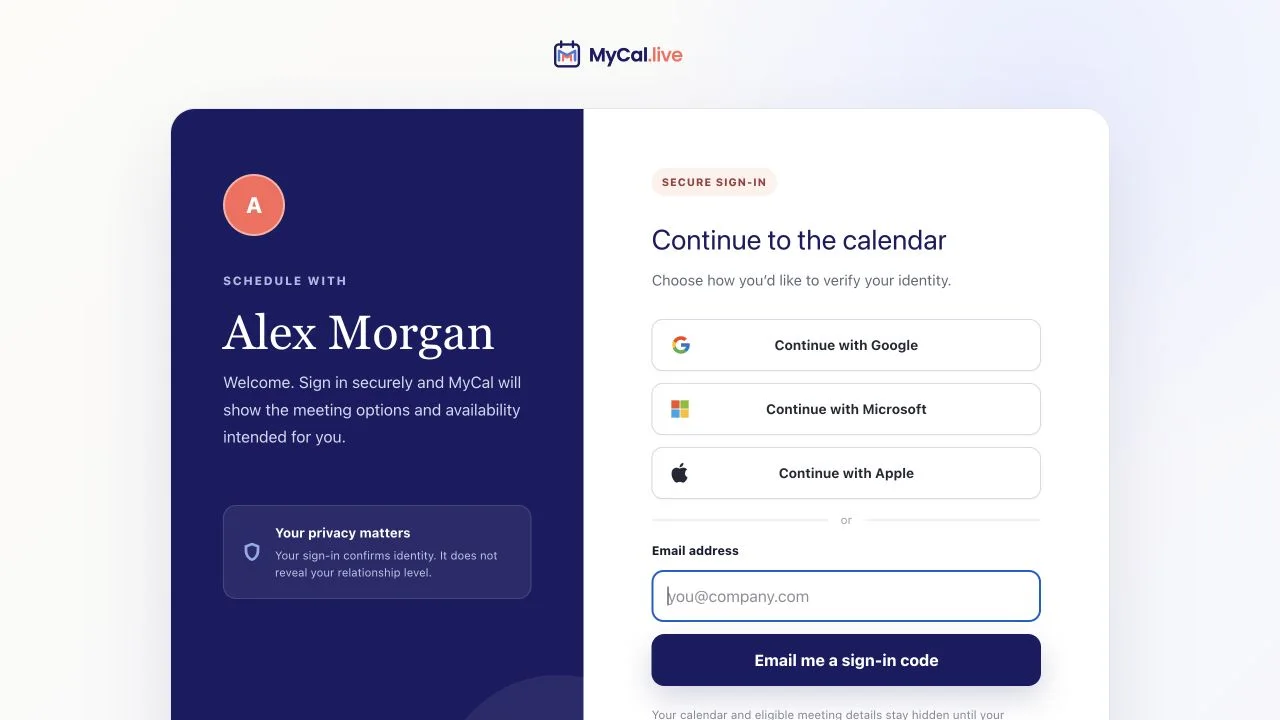
Identity-first access
Calendar details stay private until the visitor verifies an email identity.
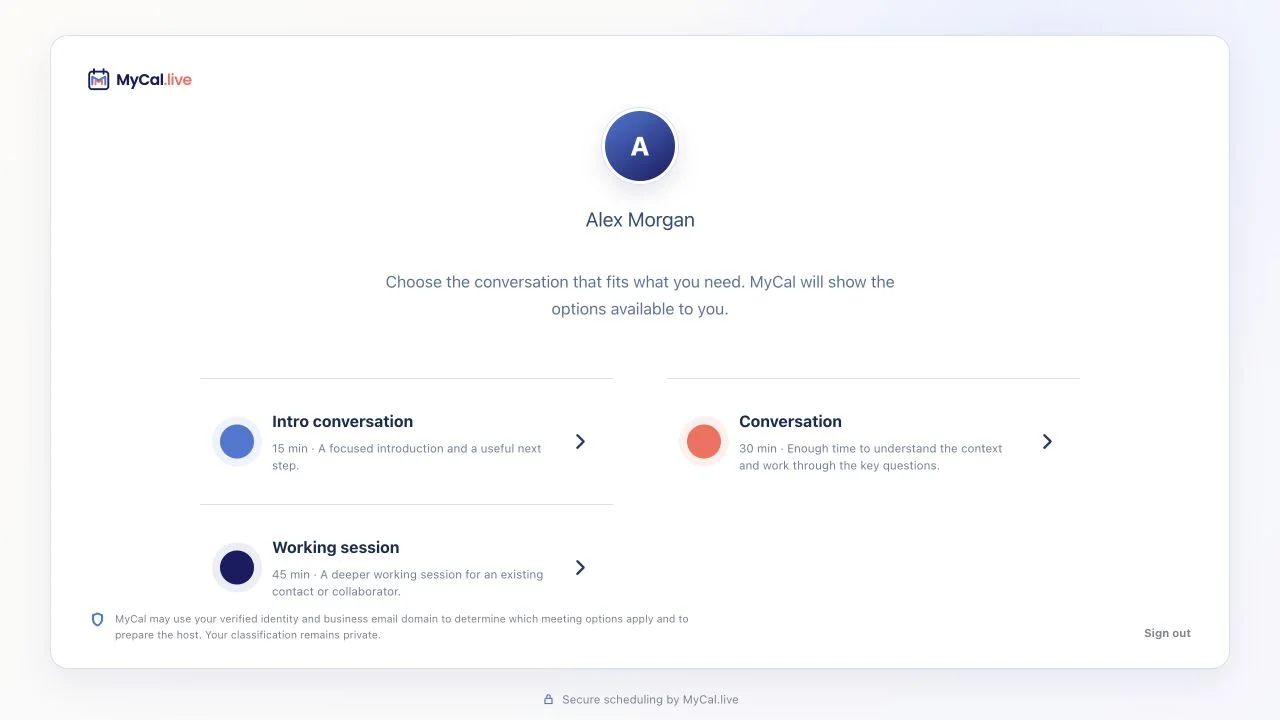
The right meeting choices
One scheduling link can offer different meeting lengths to new visitors, known contacts, and VIPs.
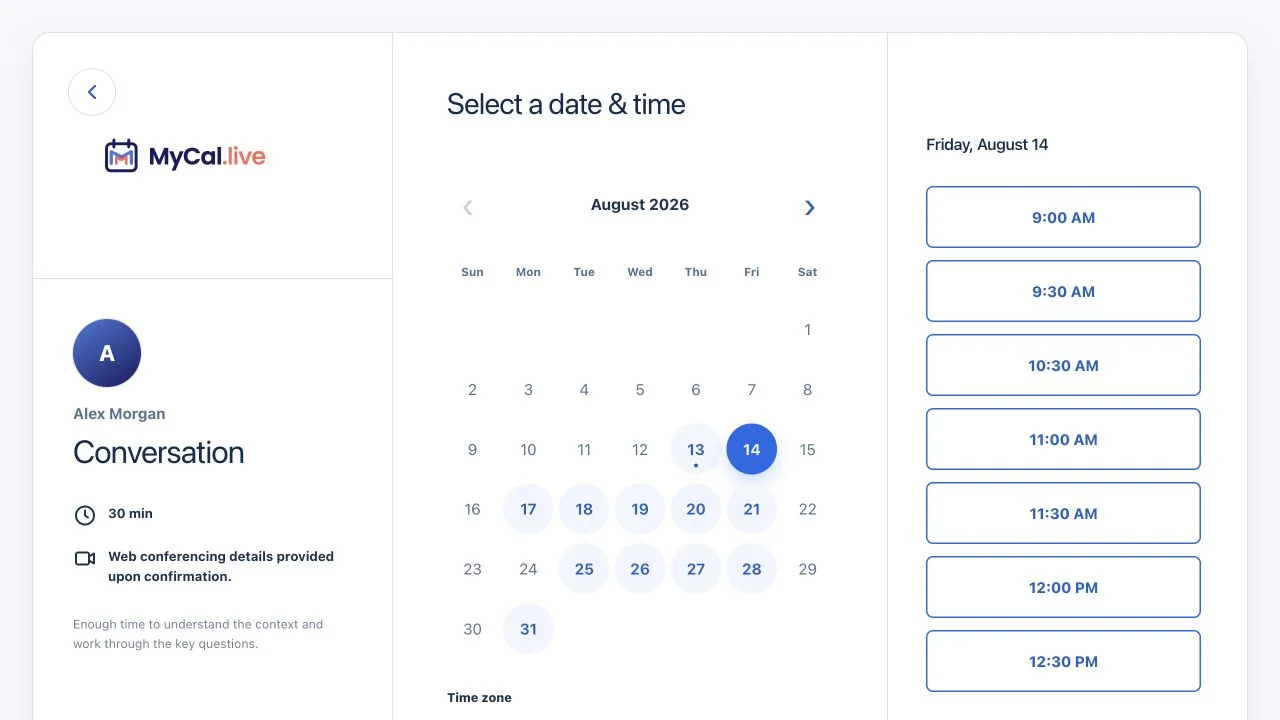
Date and time selection
Today is clearly marked while 30-minute meetings start predictably on the hour or half-hour in the visitor’s time zone.
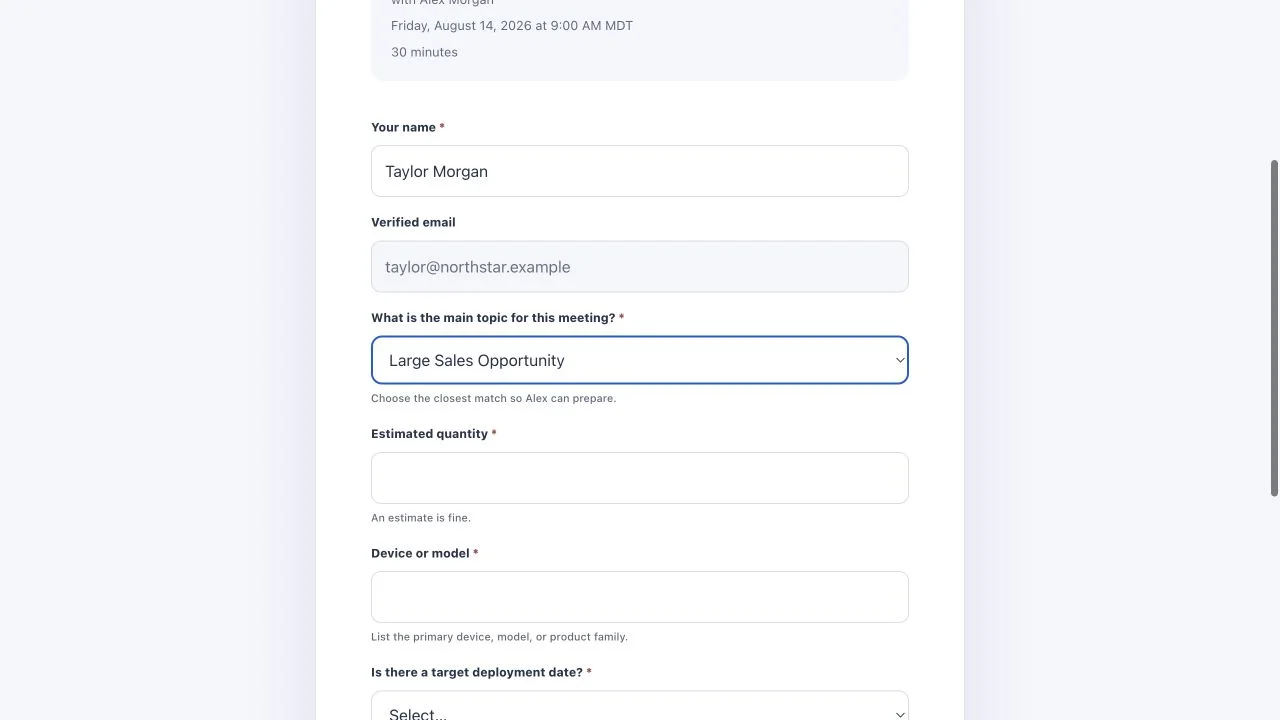
A protected, adaptive intake flow
A live ten-minute hold protects the time while the event’s answers reveal only the relevant required follow-ups.
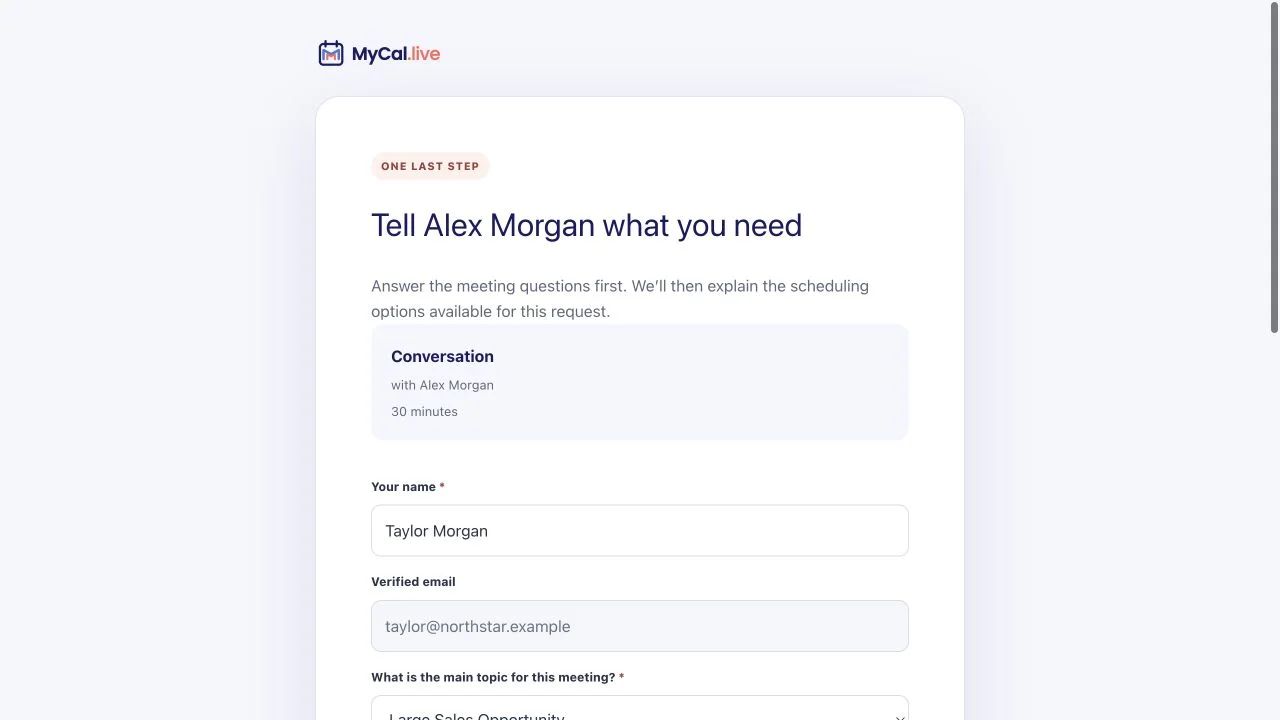
No-time requests still capture intent
When access rules or the visitor’s relationship-specific booking window leave no eligible opening, MyCal gathers the relevant event questions first and can privately alert the host without exposing the reason to the visitor.
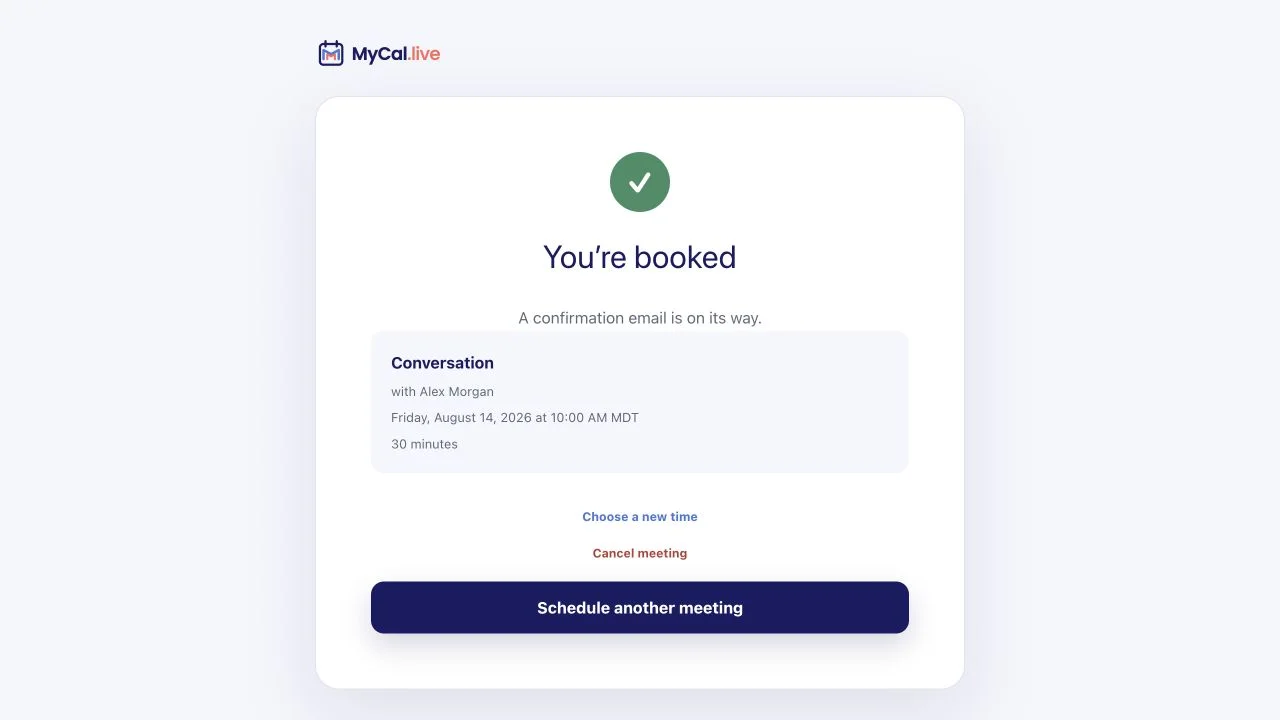
Confirmed and ready
MyCal confirms the reservation and sends the calendar invitation and authenticated email updates.
For the host
Control the experience behind your scheduling link.
The host workspace keeps scheduling, availability, private contact recognition, company context, and account controls in one place.
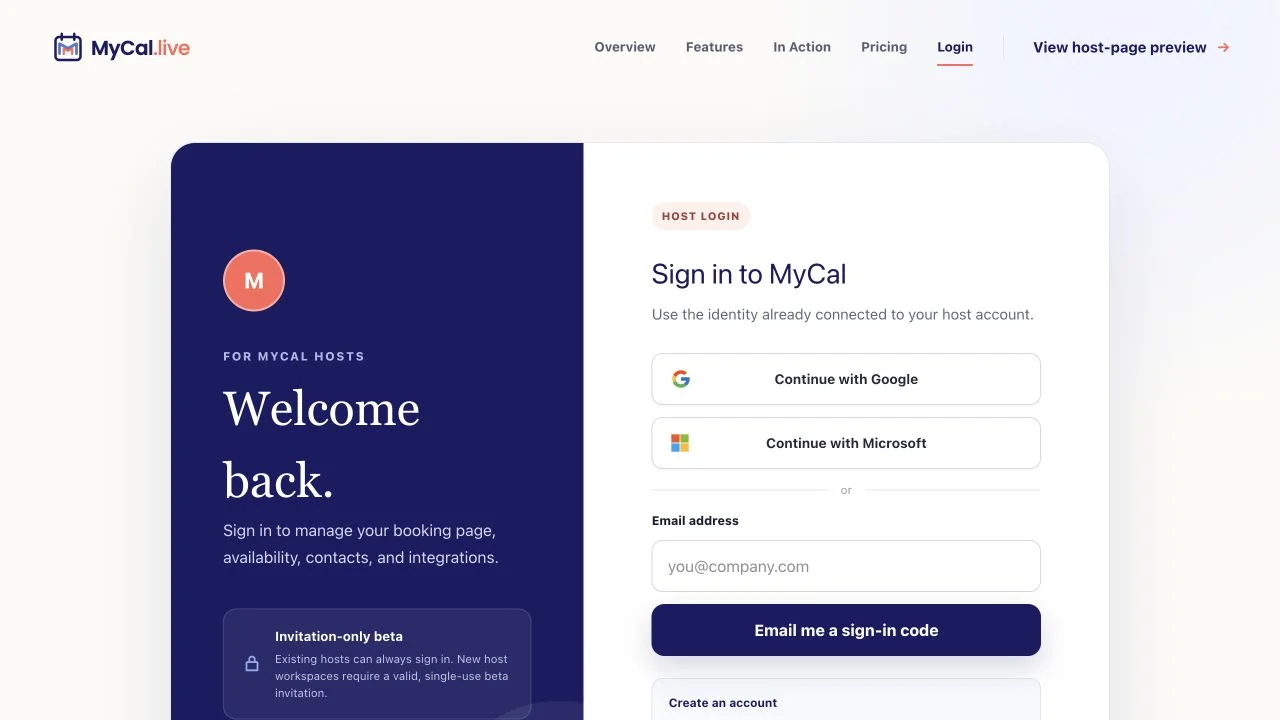
Secure host sign-in
Existing hosts return with Google, Microsoft, or verified email; invited hosts first reserve a unique public booking address with live availability checks.
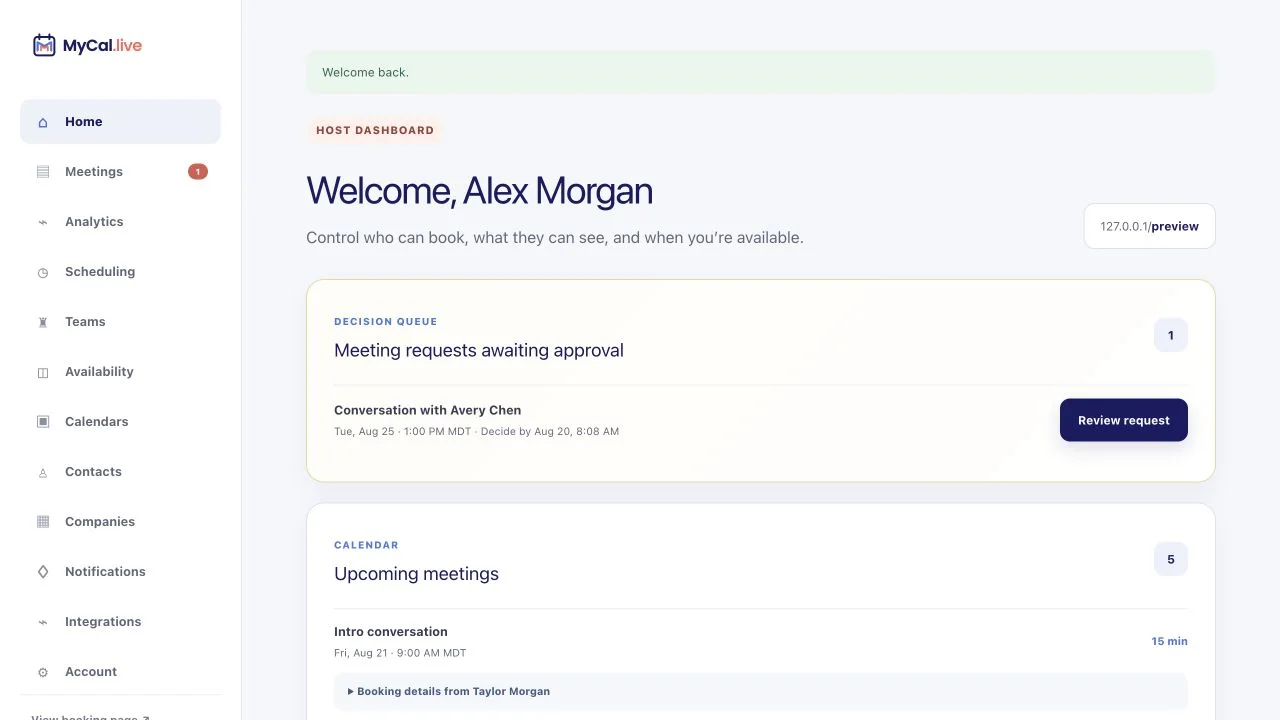
Host overview
A practical home for the host’s link, upcoming activity, and connected scheduling controls.
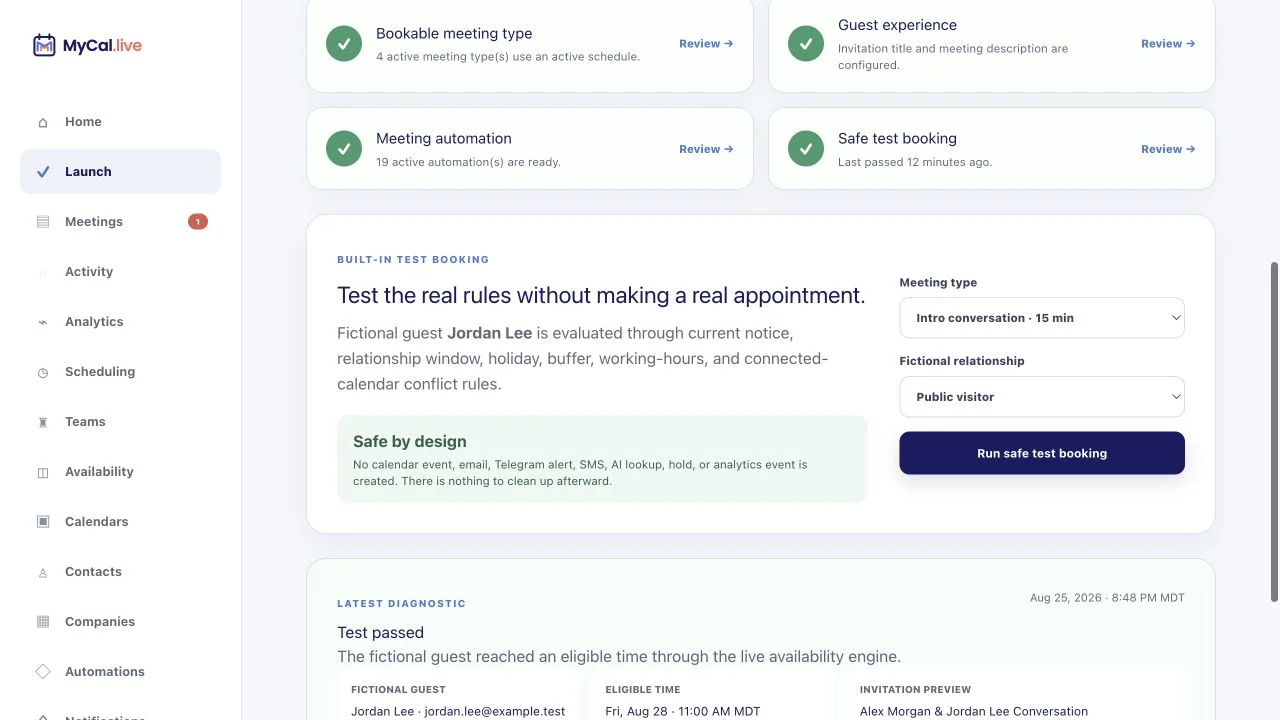
Guided launch readiness
Check every launch dependency and send a fictional guest through the real availability and conflict engine without creating an appointment, sending messages, using AI or SMS, or changing analytics.
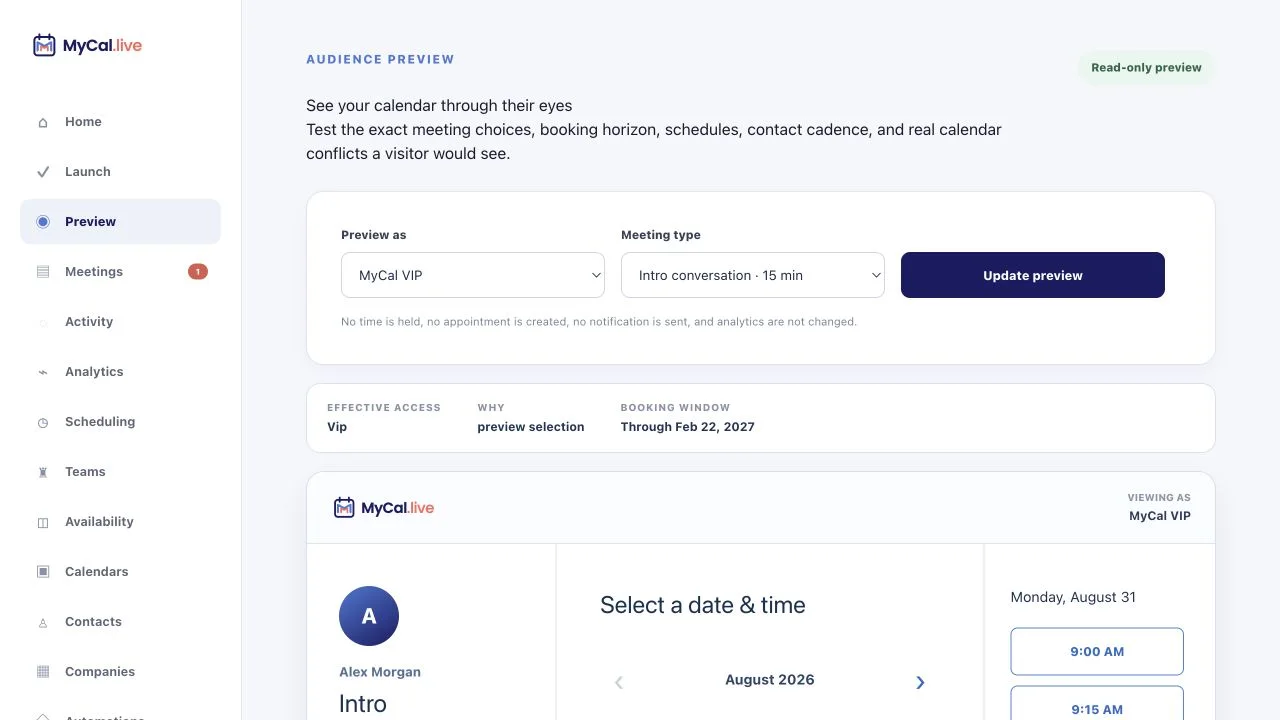
See the calendar each audience receives
Switch among Public, Known, VIP, blocked, or a specific email and inspect the real event visibility, schedules, horizons, cadence, and calendar conflicts without holding a time or creating an appointment.
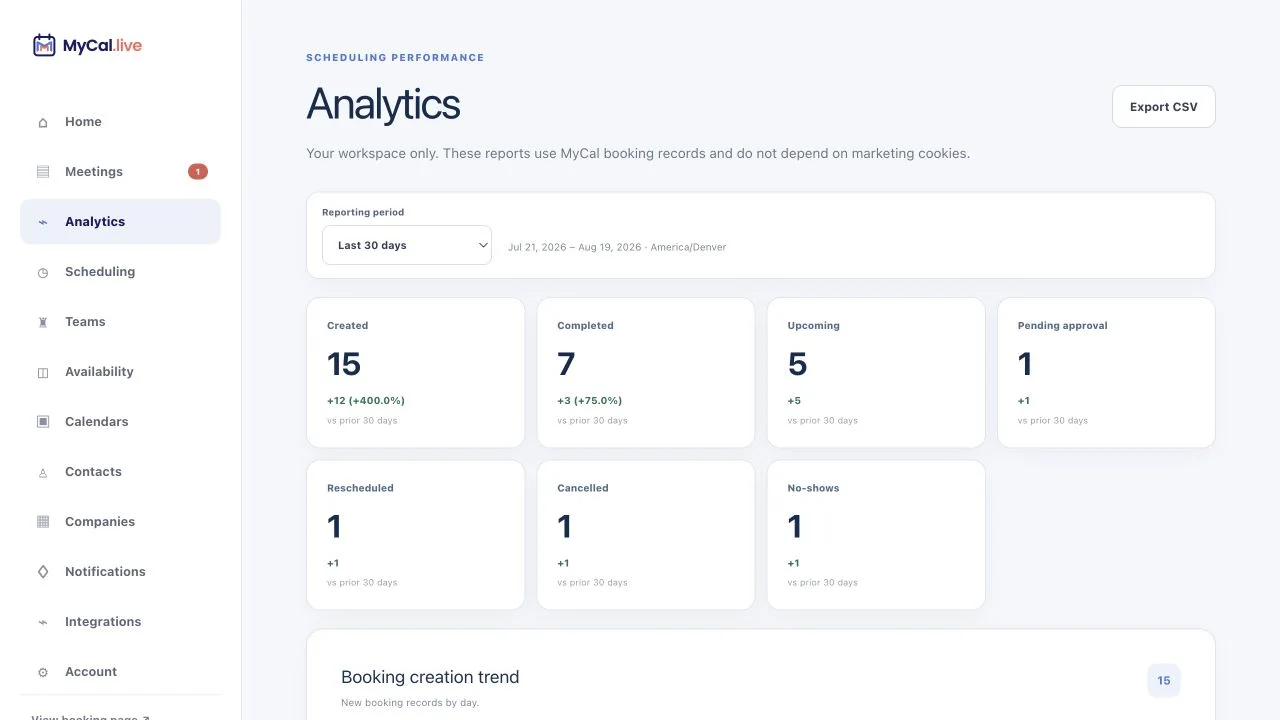
Private scheduling analytics
Compare created, completed, upcoming, pending, rescheduled, canceled, and no-show meetings across selectable periods, then export the host-only report to CSV.
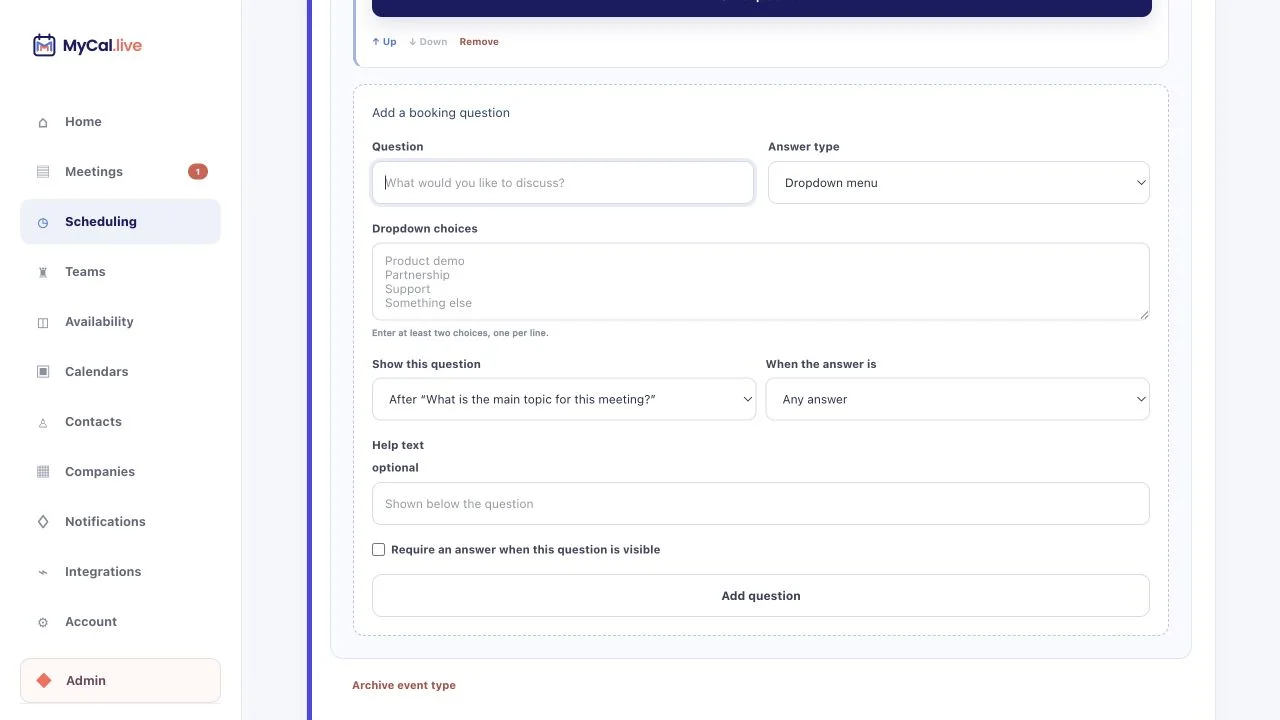
Event types and conditional intake flows
Choose invitation titles, build and preview exact-answer or any-answer follow-ups, copy the complete flow, and offer links that disappear after one booking.
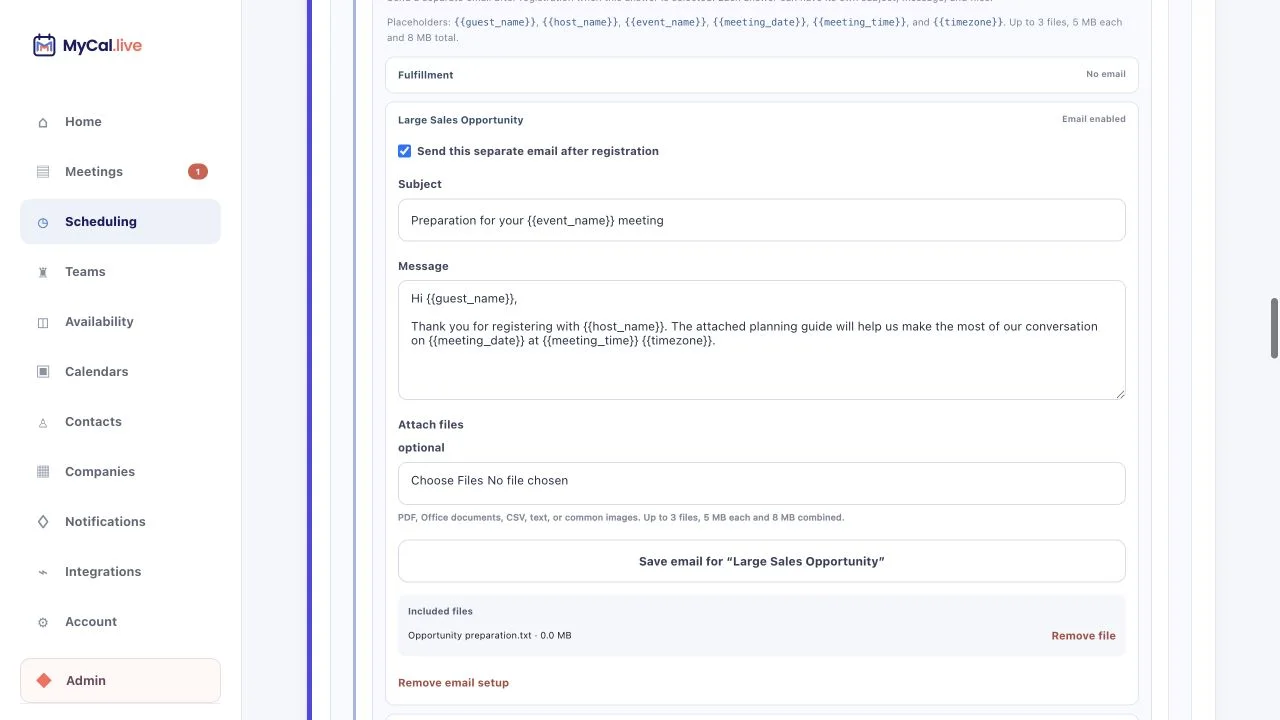
Answer-triggered preparation emails
Each dropdown or Yes / No answer can send its own separate post-registration email and preparation files, with delivery-friendly attachment limits and copy-safe event settings.
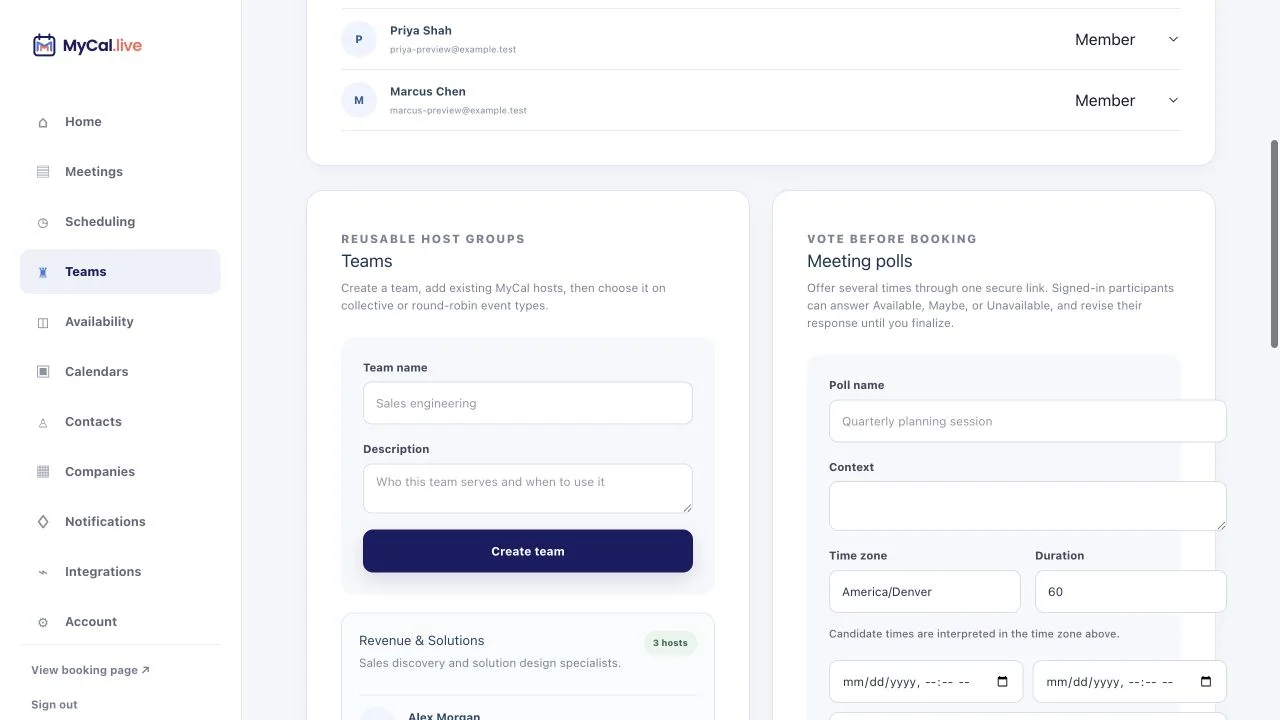
Teams and secure meeting polls
Reuse existing hosts for group, collective, or weighted round-robin scheduling, then offer several private time choices when a shared time is not yet known.
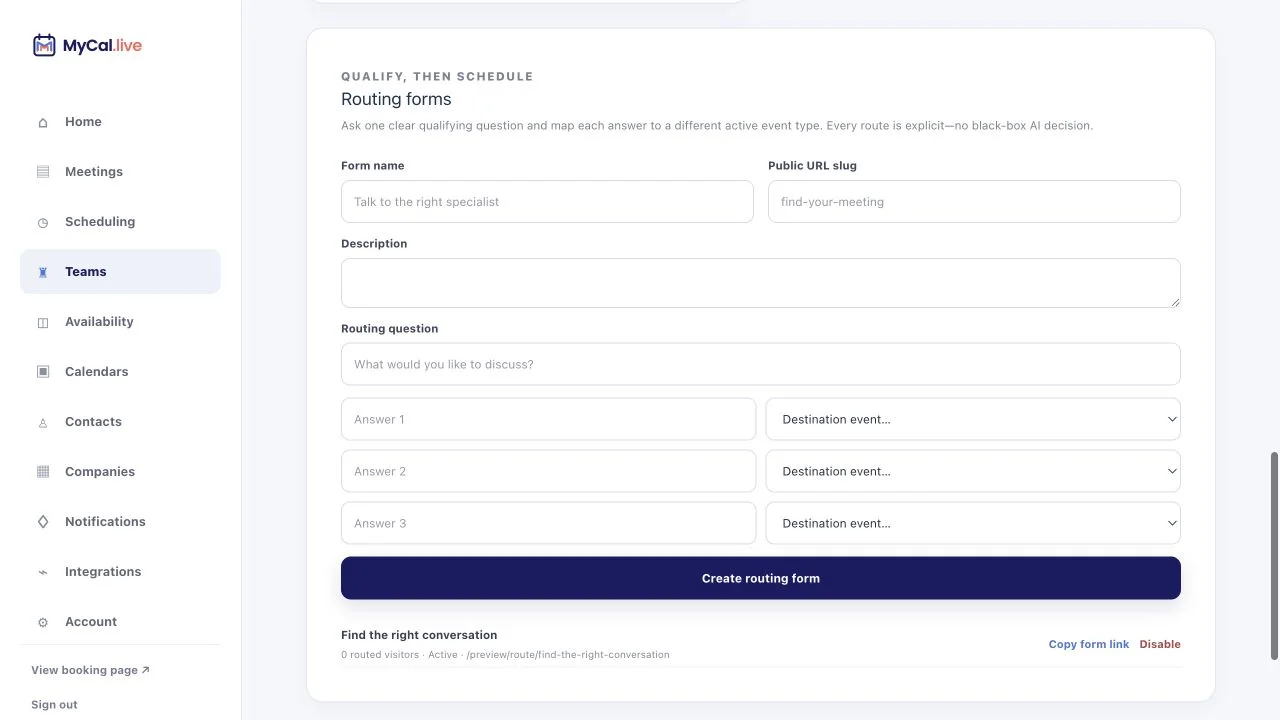
Explicit routing forms
Ask one qualifying question and send each answer to a host-selected event type with a transparent rule and an auditable submission history.
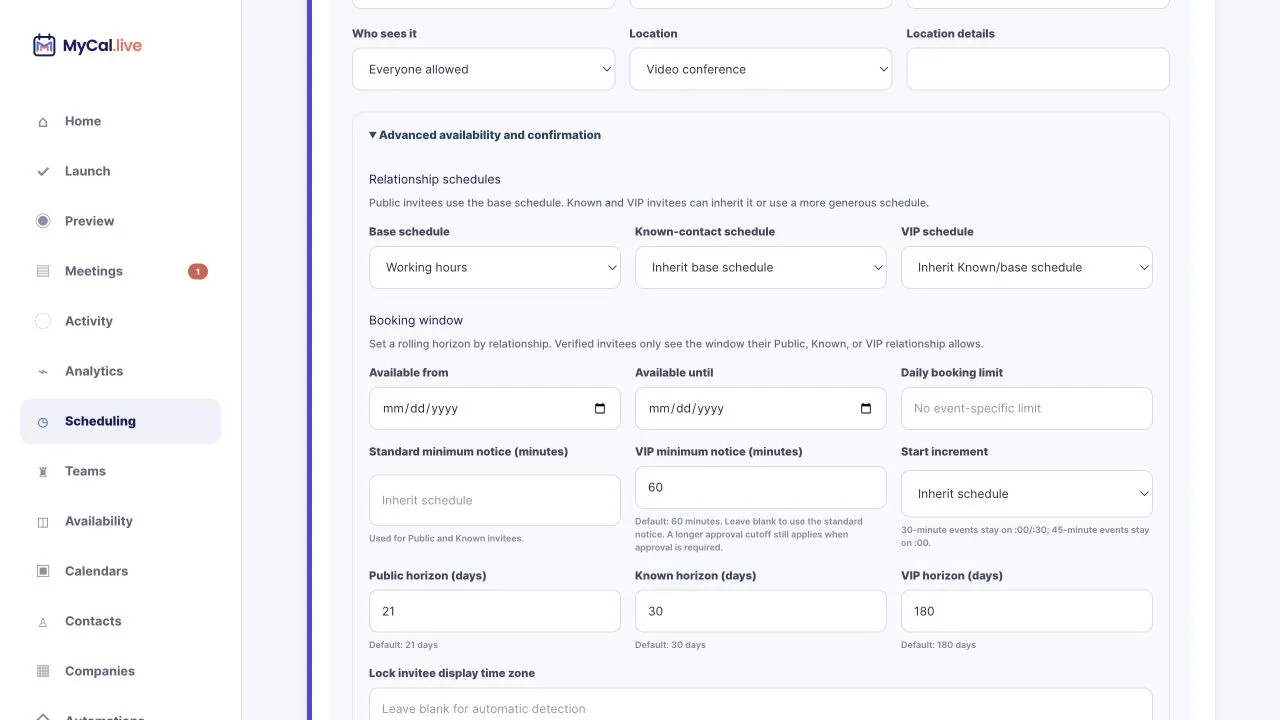
Advanced event, guest, and approval controls
Let invitees add other attendees when appropriate, then give VIPs a shorter minimum notice and each relationship its own schedule and rolling booking window—without creating separate scheduling links.
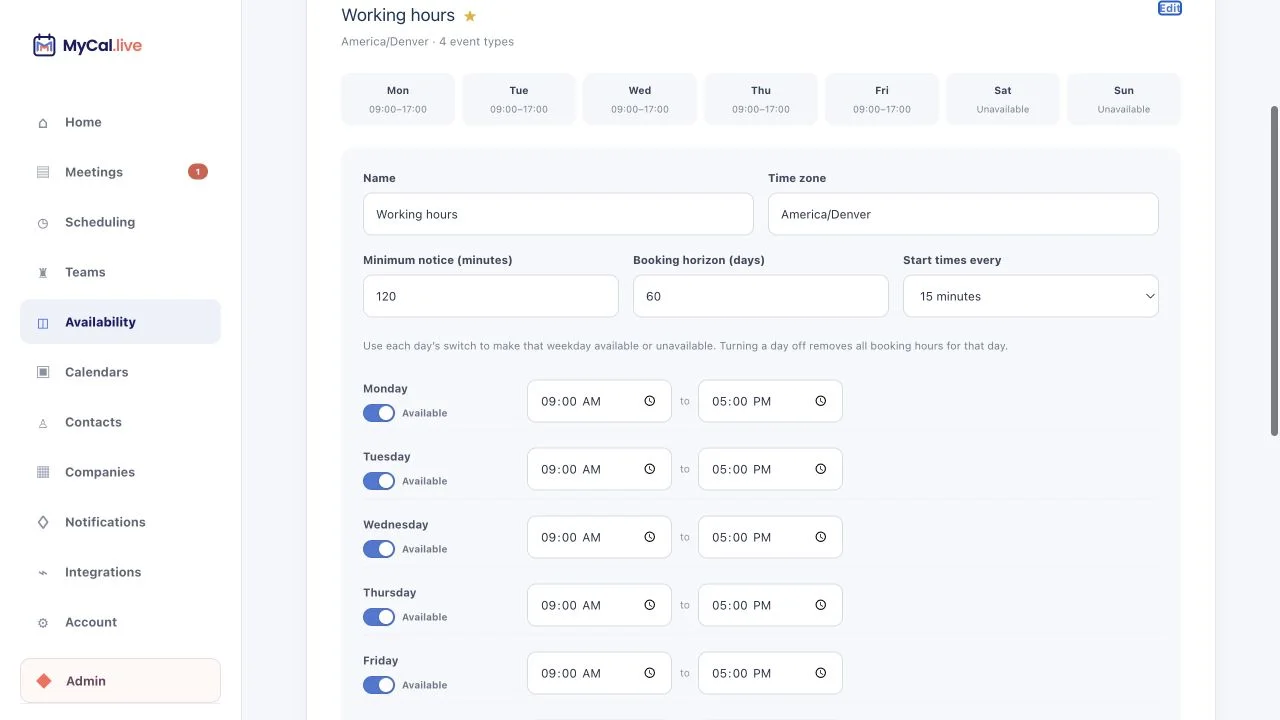
Clear weekly availability controls
Named schedules use a clear switch for each weekday, complete time ranges, date-specific overrides, and an editable regional holiday calendar.
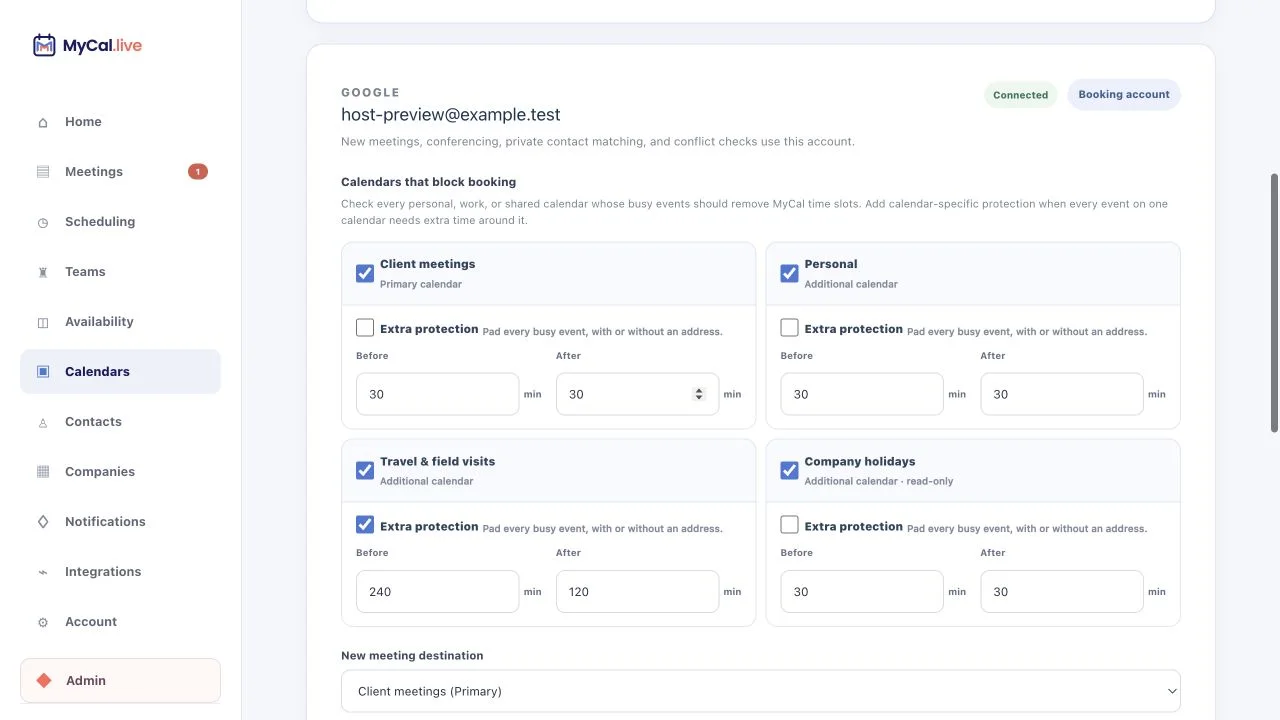
Multiple accounts, one booking destination
Combine calendars across accounts, choose one booking destination, and give travel or field-service calendars their own protection around every busy event.
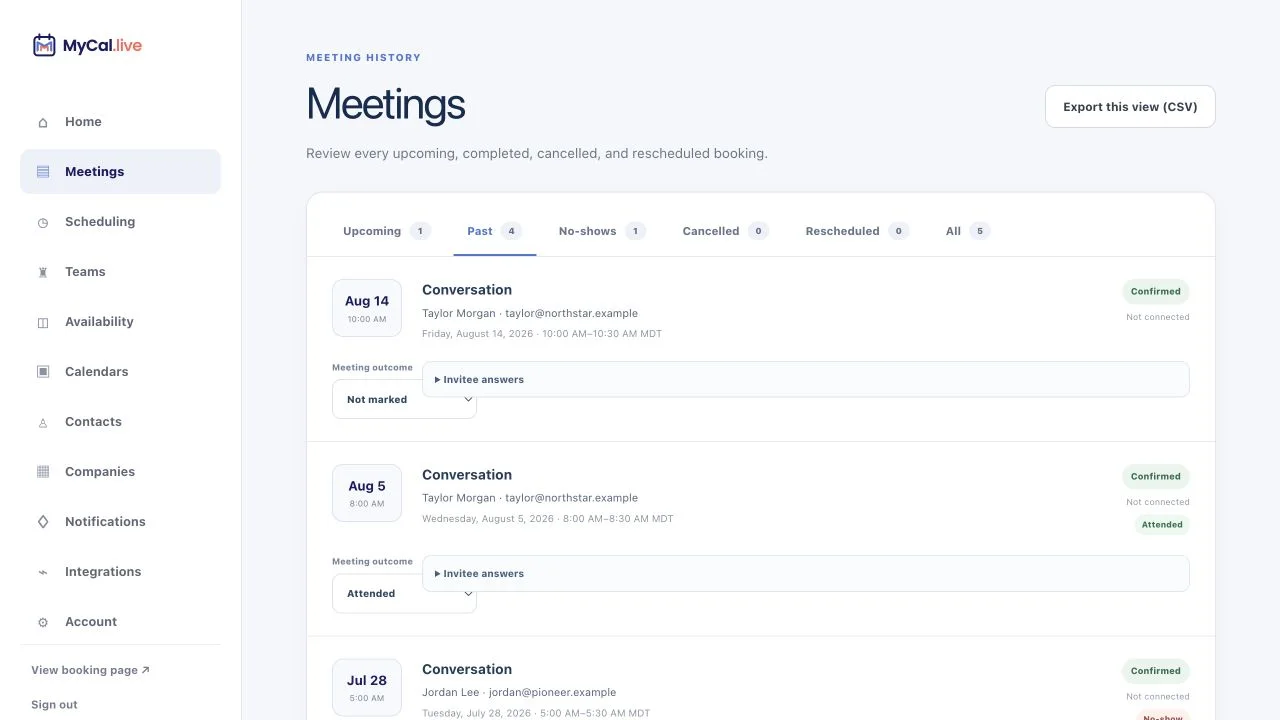
Meeting history, outcomes, and CSV export
Review every booking state, explicitly record Attended or No-show for past meetings, and stream the selected view to CSV without retaining an export file on the server.
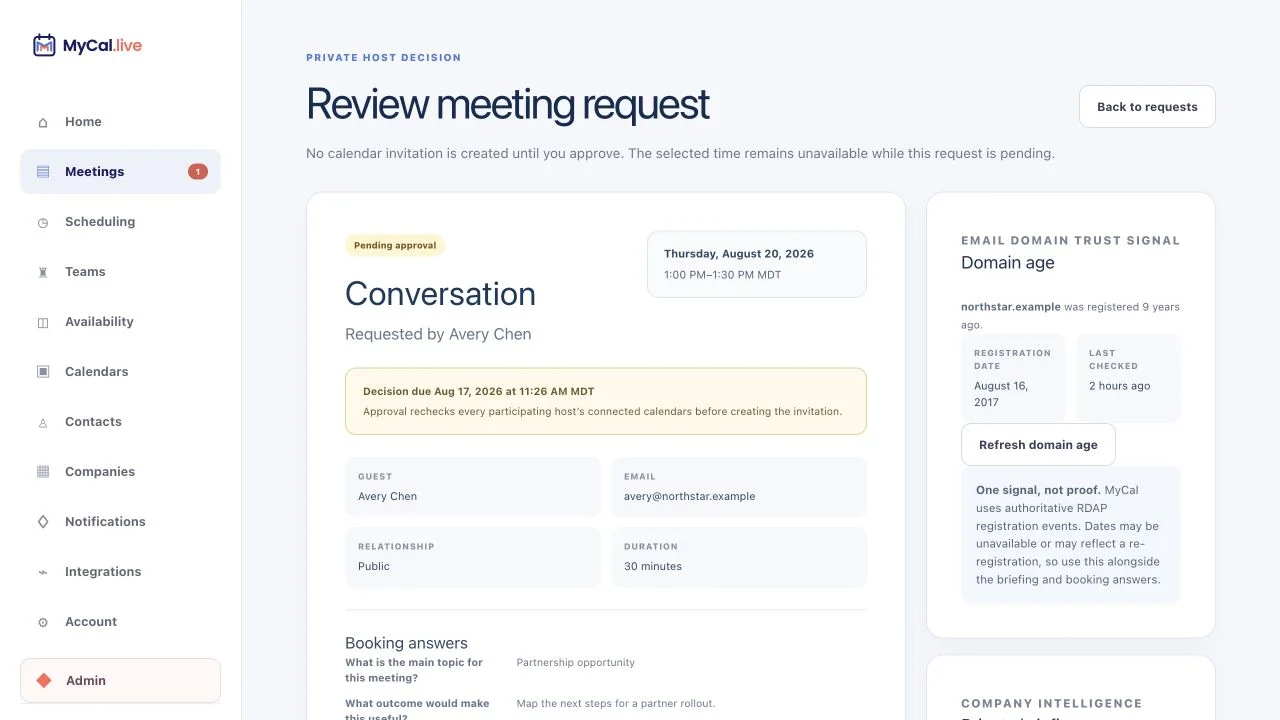
Company-aware meeting approval
Protect the requested time while reviewing the guest, conditional answers, authoritative domain-age signal, and authenticated company research; approval rechecks every participating calendar before MyCal creates the invitation.
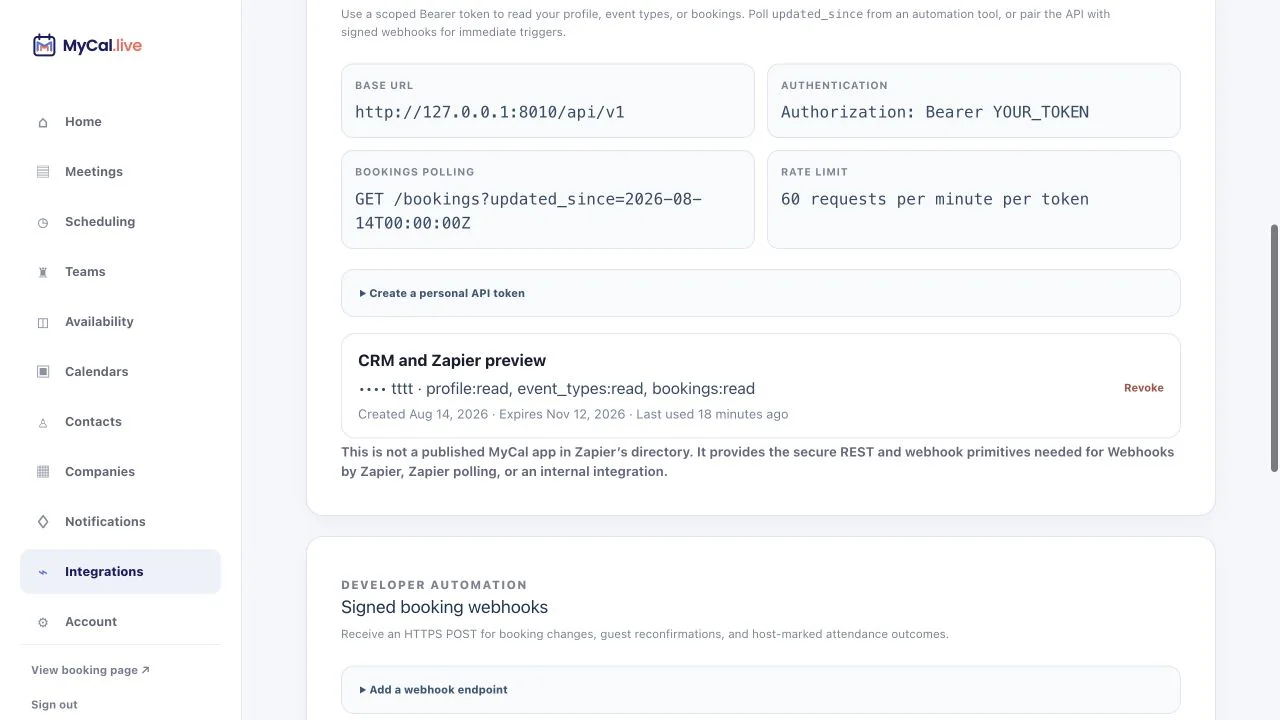
Website embeds, personal API, and signed webhooks
Connect an internal workflow with expiring read-only tokens, Zapier-compatible polling, or HMAC-signed events while keeping secrets one-time-display and individually revocable.
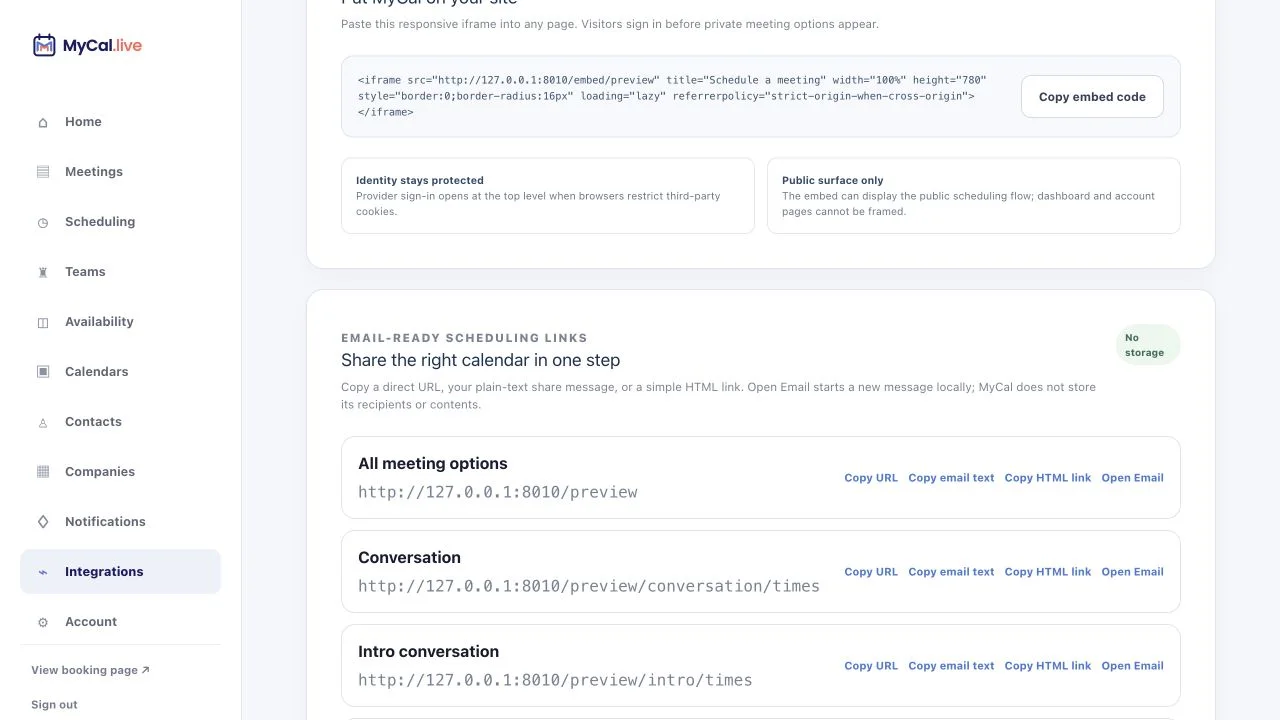
Email-ready scheduling links
Share all eligible meeting choices or one focused event without MyCal storing a recipient or draft; reusable wording stays editable under Account.
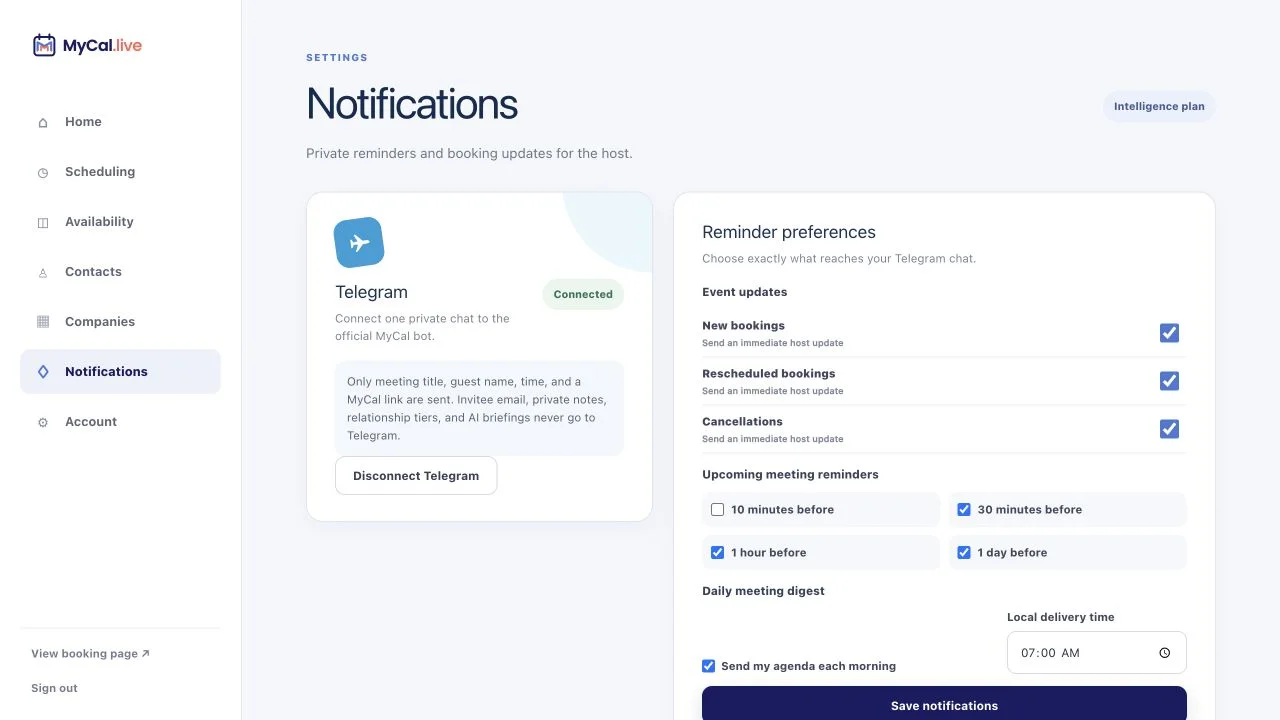
Private Telegram reminders
Connect the official MyCal bot once, then choose which booking changes, advance reminders, and daily agenda updates reach your private Telegram chat.
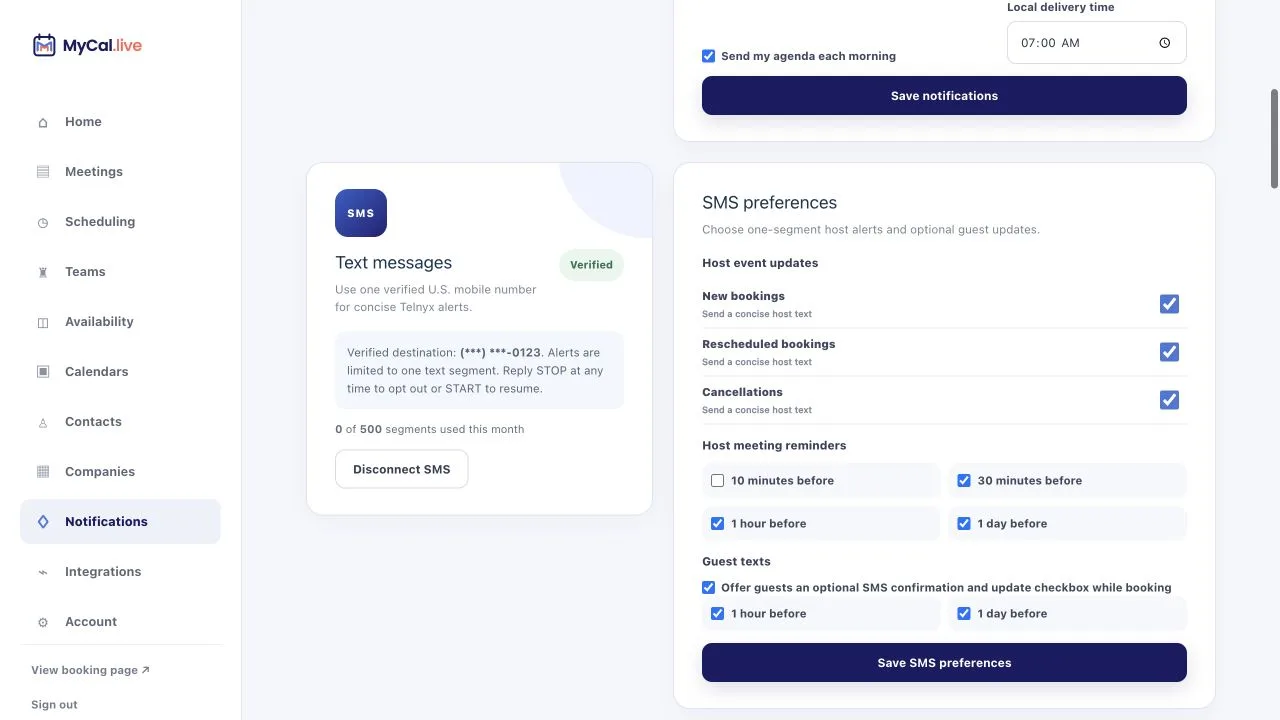
Consent-first Telnyx SMS controls
Verify one host number, choose one-segment alerts, and optionally let guests expressly opt into transactional confirmations and reminders; STOP, START, HELP, deduplication, and allowance guards are built in.
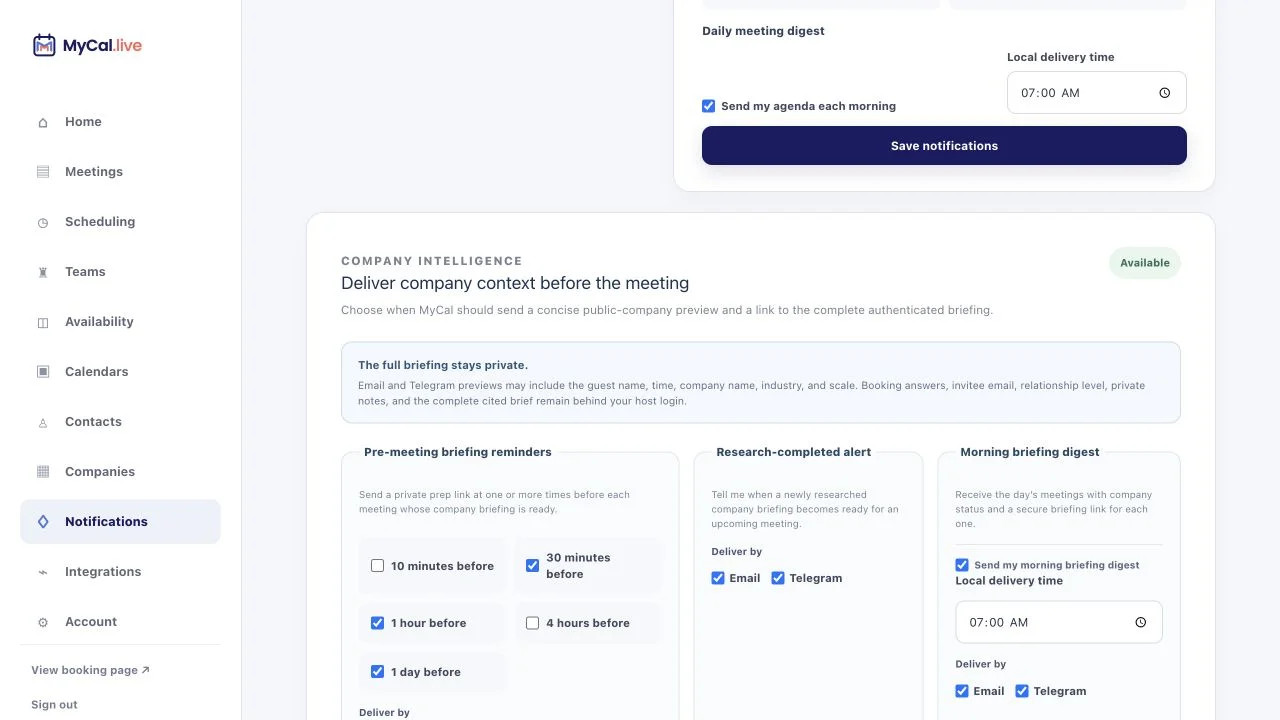
Briefing delivery on your schedule
Opt into the moments and channels that help: research completion, one-segment SMS or richer pre-meeting reminders, last-minute preparation, or a morning digest with secure links.
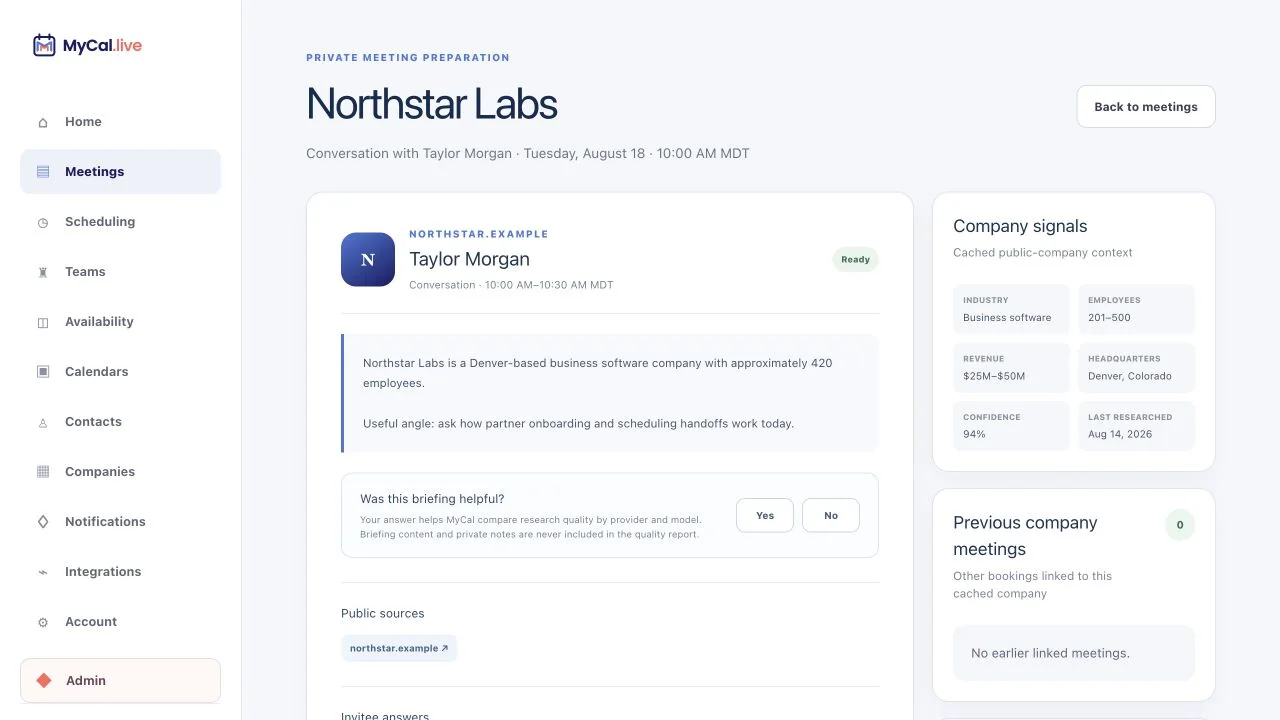
One authenticated meeting-prep workspace
Review the complete cited brief behind host sign-in, then mark it helpful or not helpful so MyCal can compare provider and model quality without including private meeting content in the report.
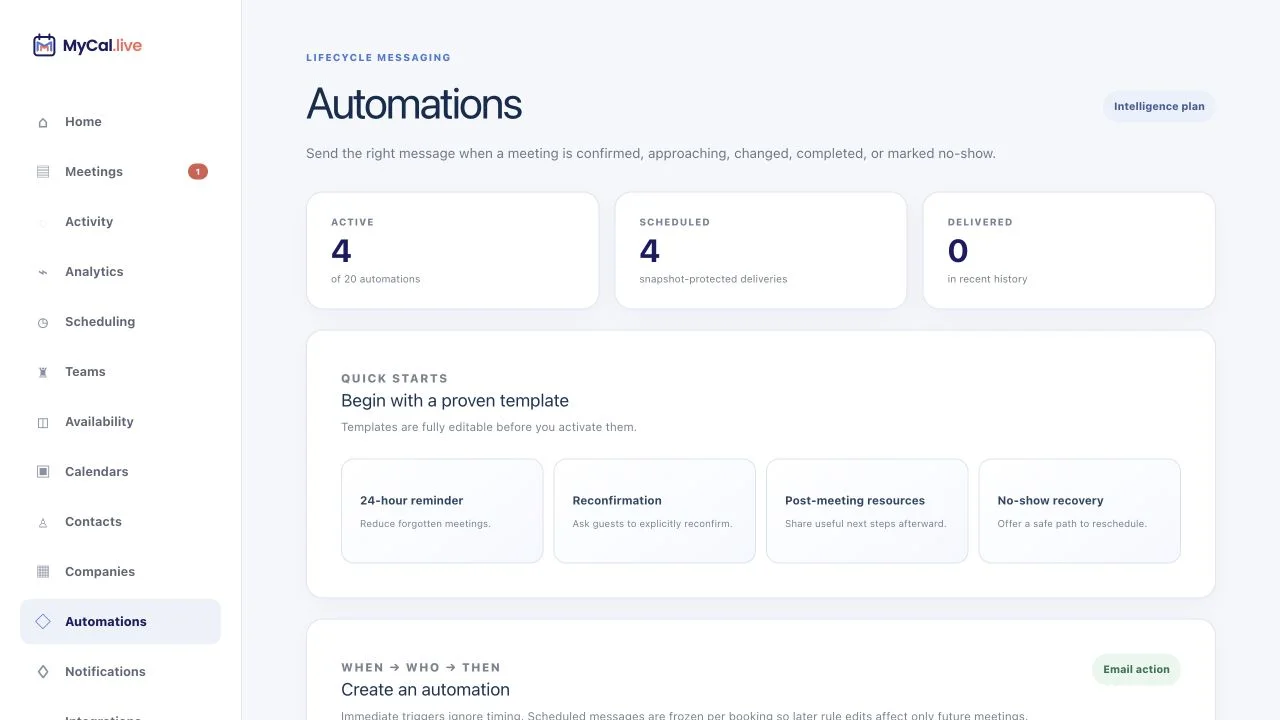
Versioned lifecycle automations
Start from an editable template, choose the trigger, event scope, timing, and recipient, then preview or test it; scheduled messages keep their original version when a rule changes later.
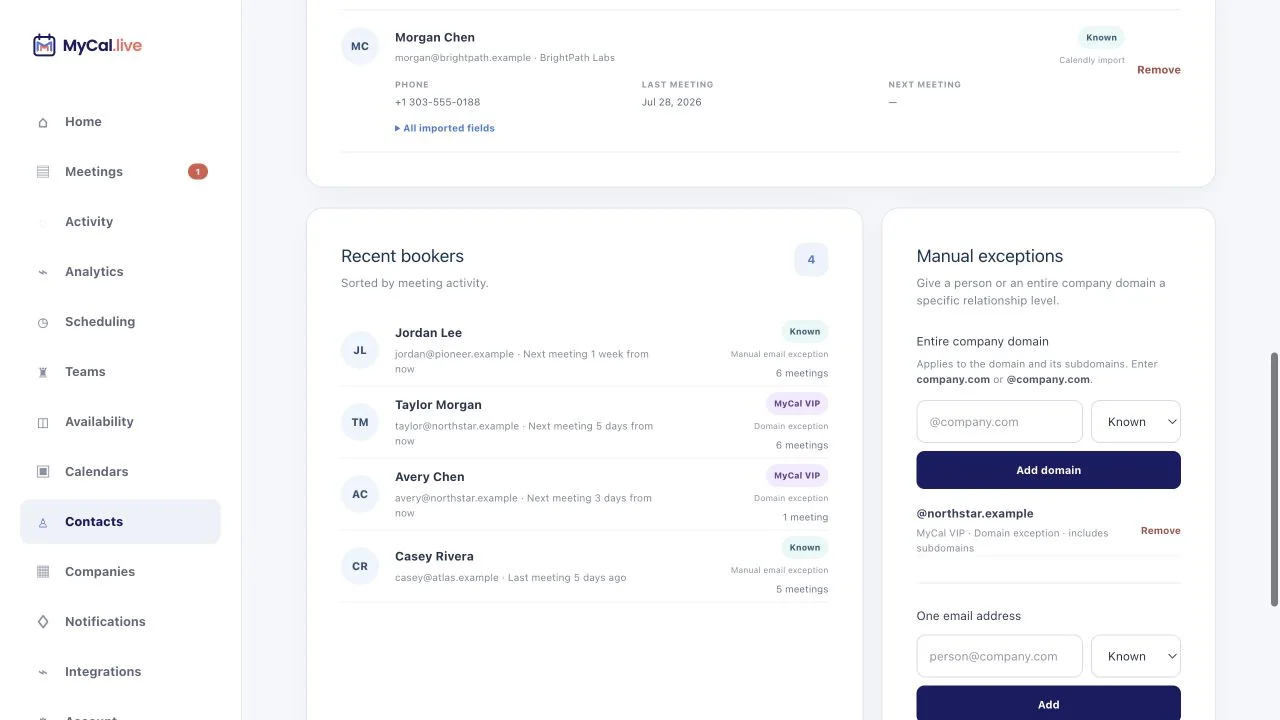
Visible access labels and private migration
See the effective relationship level and its source on every readable contact—including email and domain exceptions—while Google and Microsoft address-book matching remains private and one-way.
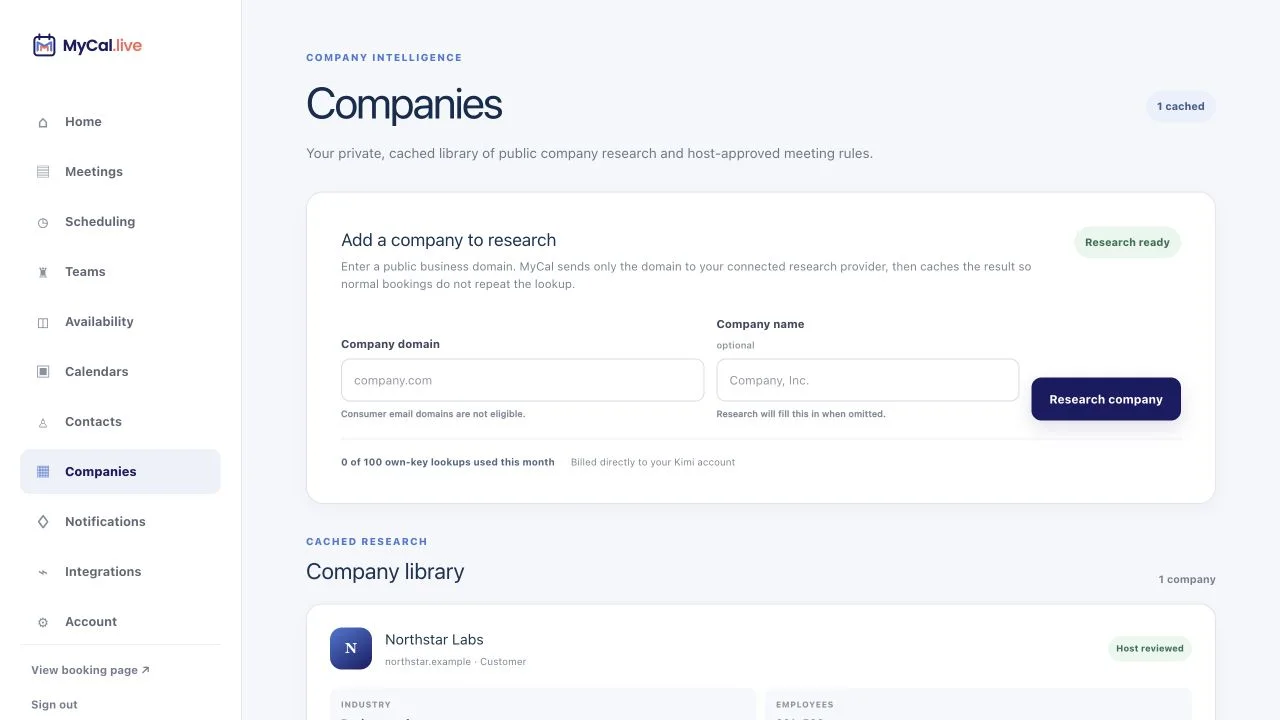
Allowance-aware company intelligence
Use five included beta lookups or connect Anthropic, DeepSeek, Kimi, OpenRouter, Perplexity Sonar, or xAI Grok; OpenRouter starts with Ox Alpha and accepts other catalog model IDs, while cached profiles remain reusable without another lookup.
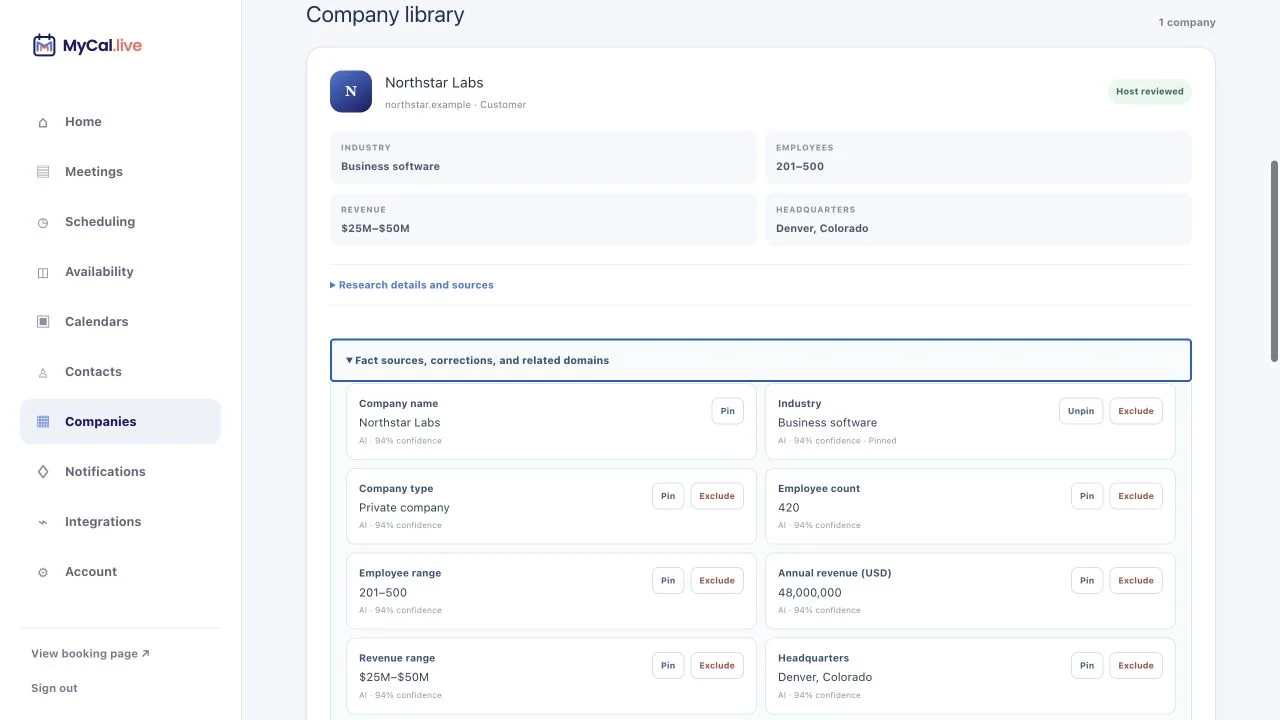
Reviewed facts with field-level control
Inspect each fact’s provenance and confidence, then correct, pin, exclude, or restore that field without discarding the rest of the cached company profile.
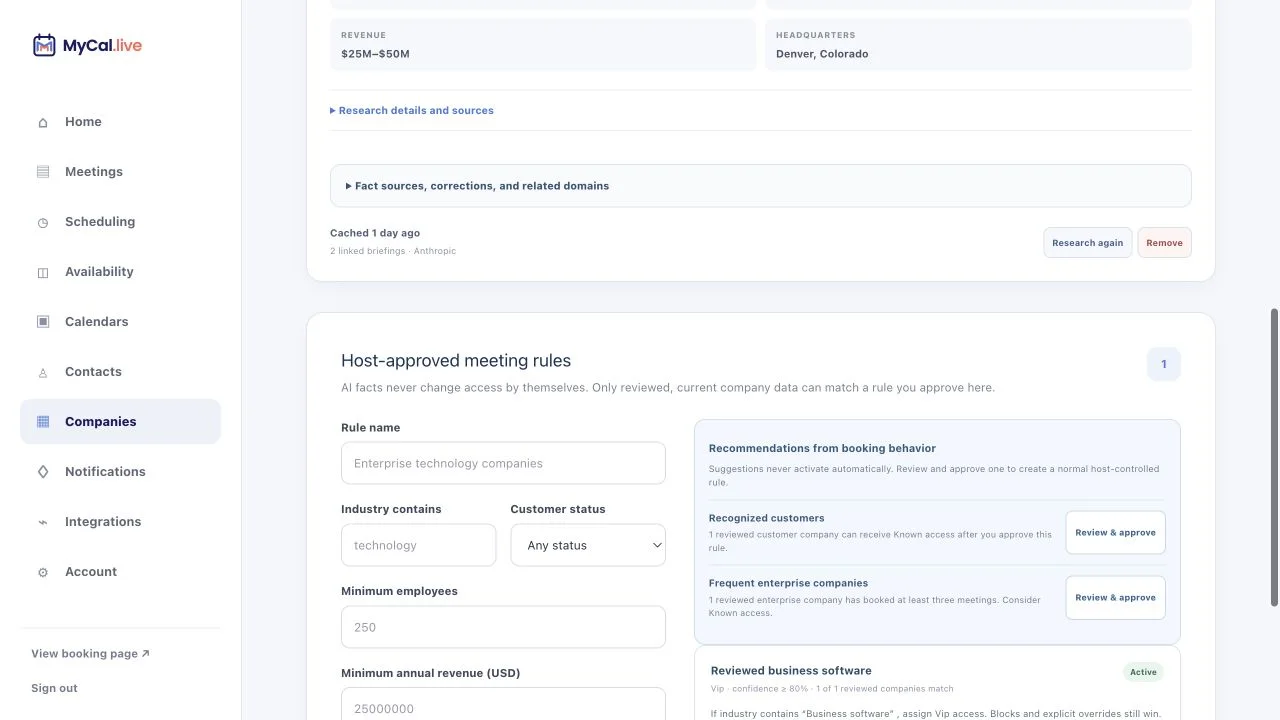
Explainable rules and opt-in recommendations
Connect customer status and related-domain context to deterministic rules, preserve each approved version, and review recommendations before they can change meeting access.
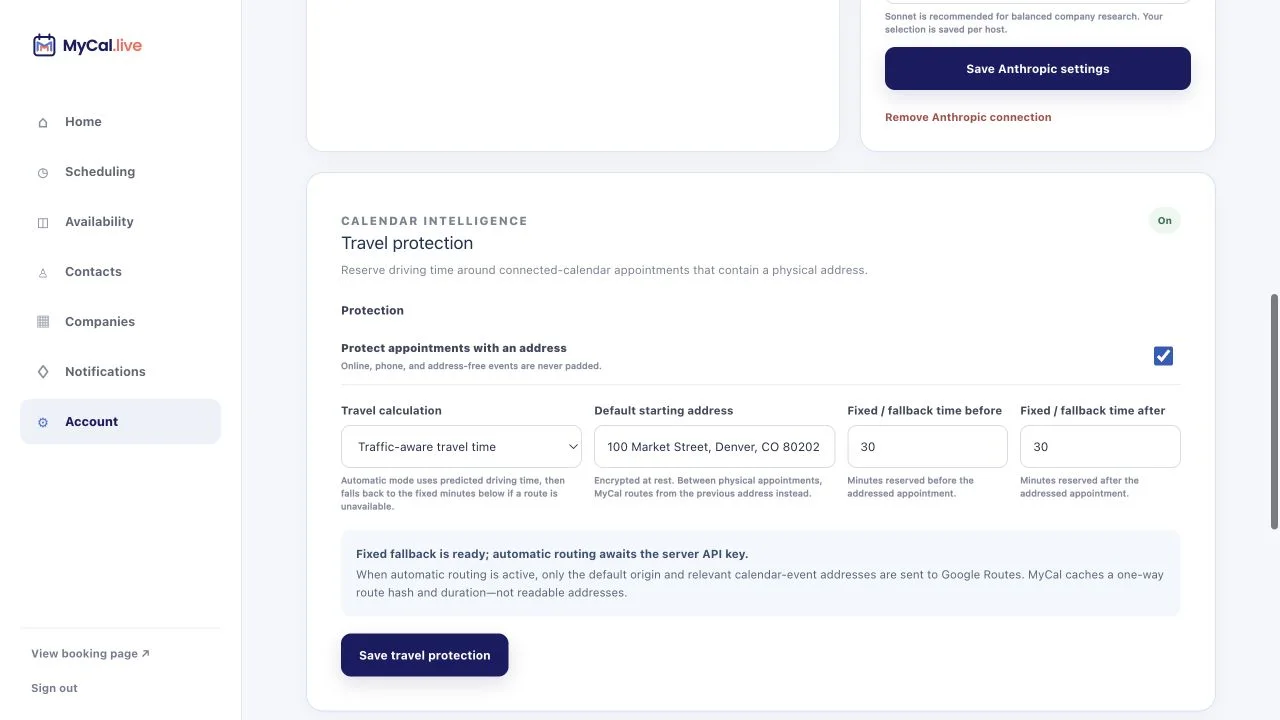
Travel time that protects the drive
Turn travel protection on only when wanted, begin with 30 minutes in each direction, customize the before and after values independently, or estimate driving time between addressed appointments.
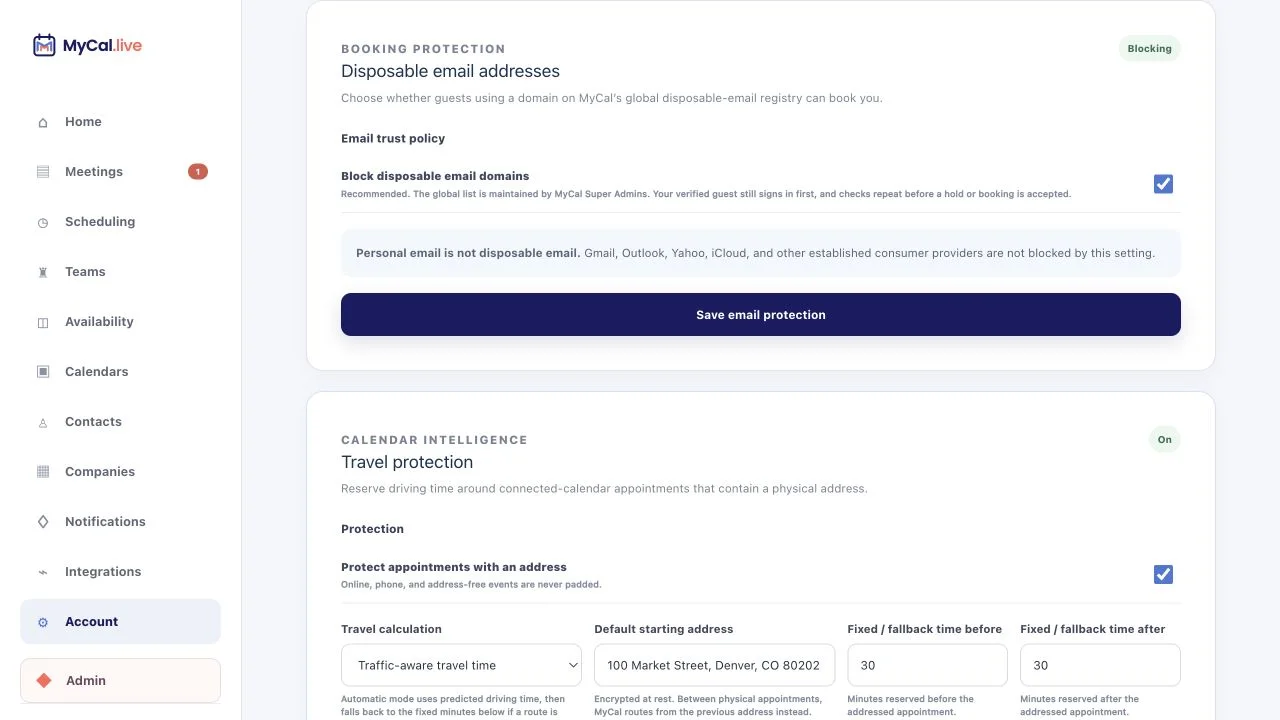
Account, profile, and booking protection
Control public profile, company research, and whether verified guests from globally managed disposable-email domains may book this host.
For anyone exploring MyCal
Product answers grounded in current MyCal sources.
This activation-ready public guide explains documented features and beta availability, shows its MyCal sources, and refuses to invent an answer when the evidence is weak.
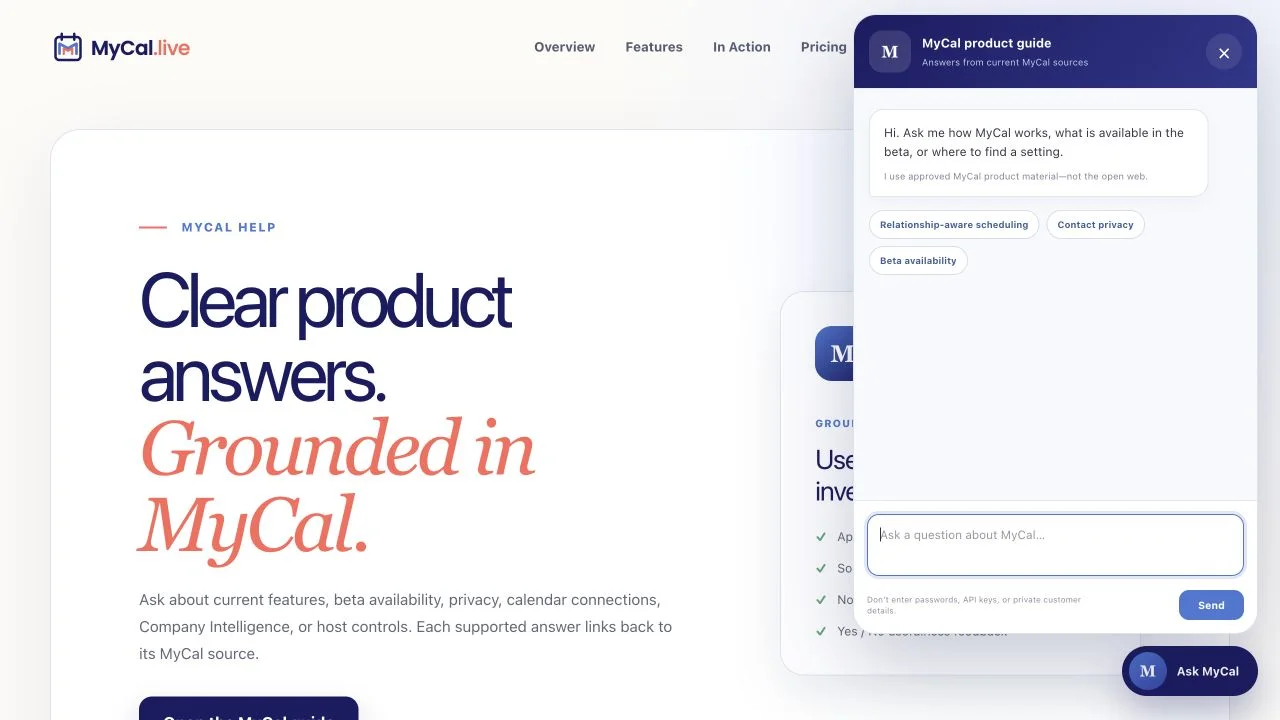
Source-grounded product help
The activation-ready guide opens from public marketing pages, starts with suggested questions, and is designed for source-linked answers without open-web search or account-action access.
See what powers the experience.
Review the complete MyCal feature catalog, including private contact matching, availability controls, calendar coordination, and company-aware meeting preparation.